04 / Case Study
AI Productivity & Platform Modernization
A consulting engagement focused on applying practical AI to business workflows while modernizing frontend and backend applications.
I worked directly with clients to clarify requirements, introduce LLM-powered capabilities, develop Python and Node.js services, refactor legacy applications, integrate APIs, support cloud deployment, and troubleshoot production systems.
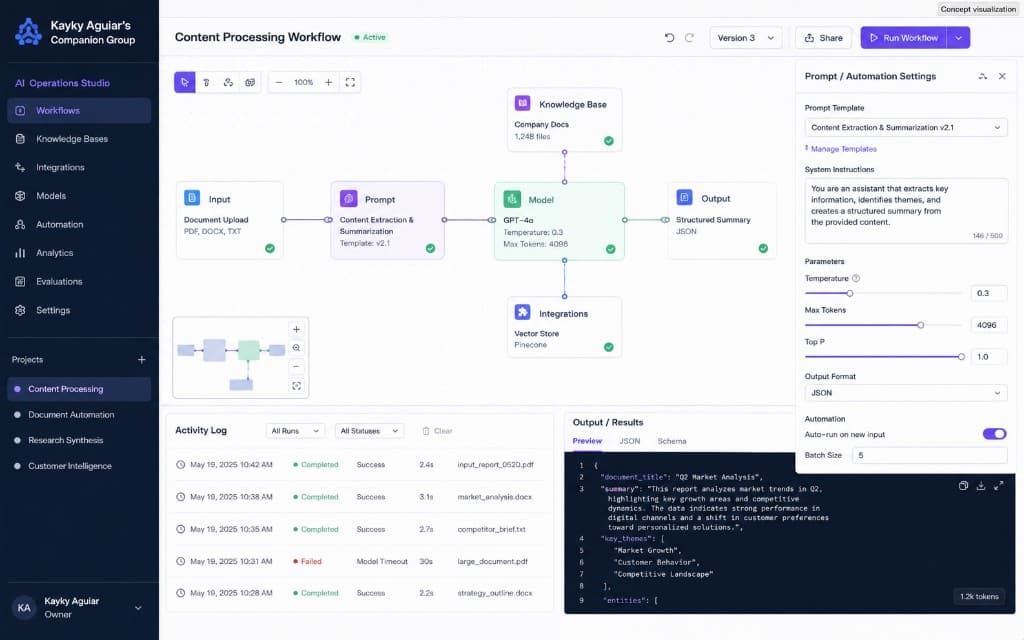
Concept visualization of the confidential AI workflow and modernization engagement.
Product context
What the product was
The engagement covered AI implementation, application refactoring, and full-stack modernization for retail and business-facing platforms.
Instead of creating AI features as isolated demonstrations, the work focused on integrating them into existing products and internal workflows where they could support content processing, automation, and productivity.
The challenge
Business and technical constraints
These were the product pressures the team needed to address. My engineering responses focused on the areas where I contributed.
Challenge 01
Practical AI integration
AI capabilities needed to fit real business workflows rather than operate as disconnected prototypes.
Engineering response
Integrated LLM APIs into business workflows with prompt engineering, structured outputs, and service logic for content processing.
Challenge 02
Legacy application complexity
Existing React, Angular, Node.js, and Python codebases required improvement without disrupting ongoing business use.
Engineering response
Refactored legacy React and Angular applications to improve clarity, maintainability, and long-term extensibility.
Challenge 03
Multiple service boundaries
Frontend applications, APIs, Python services, model providers, and cloud environments needed clear responsibilities.
Engineering response
Separated frontend workflows, Node.js APIs, and Python AI-processing services with validation and error-handling paths.
Challenge 04
Changing client requirements
Consulting work required direct communication with clients and the ability to refine technical scope as business needs became clearer.
Engineering response
Worked directly with clients to clarify requirements and define realistic implementation scope as needs evolved.
Challenge 05
Production reliability
New AI functionality needed error handling, API stability, monitoring, and troubleshooting support.
Engineering response
Added validation and error-handling paths, supported cloud deployments, and investigated production issues as they appeared.
My role
How I contributed
As a Senior Full-Stack Engineer and consultant, I worked across discovery, architecture, implementation, integration, refactoring, deployment, and production support. I translated client requirements into practical workflows and connected modern AI services to existing business applications.
- Client requirement discovery
- AI feature development
- Prompt engineering
- Python services
- Node.js APIs
- React modernization
- Angular modernization
- REST integrations
- Cloud deployment support
- Production troubleshooting
What I implemented
Personal engineering contributions
Work is grouped by delivery surface. These points describe what I personally built, supported, or contributed—not the full product ownership of every visible interface.
Frontend
Modernization of business-facing interfaces connected to AI and REST services.
- Refactored legacy React applications
- Refactored Angular application functionality
- Improved frontend workflow clarity
- Connected frontend interfaces to AI and REST services
- Improved maintainability and long-term extensibility
- Resolved production-facing interface issues
Backend & APIs
Services that coordinated applications, AI processing, and external providers.
- Developed Python services for AI-processing workflows
- Built and extended Node.js APIs
- Created and integrated REST endpoints
- Coordinated communication between applications, services, and external providers
- Added validation and error-handling paths
- Supported production troubleshooting
Integrations
LLM providers, prompts, and structured outputs inside existing product workflows.
- Integrated large-language-model APIs into business workflows
- Used prompt engineering for content-processing tasks
- Developed structured input and output flows
- Supported automation and internal productivity workflows
- Handled model responses and prepared structured results for application use
Quality & Collaboration
Consulting delivery, cloud support, and production reliability.
- Worked directly with clients to clarify technical and business requirements
- Helped define realistic implementation scope
- Supported cloud deployments
- Investigated production issues
- Balanced new functionality with legacy-system constraints
Product capabilities
System capabilities
Capabilities of the product environment. Not every capability visible in the concept visualization was personally implemented by me.
- Content input
- Prompt and processing configuration
- LLM service integration
- Structured output
- Workflow automation
- REST API orchestration
- Knowledge or document processing
- Activity history
- Error states
- Application modernization
Technical architecture
AI workflow architecture
The AI functionality was treated as part of a wider application system. Frontend workflows communicated through application APIs, while dedicated service logic handled prompt preparation, model communication, response validation, and structured output.
Delivery surfaces
Frontend, backend, integrations, and quality
Frontend implementation
- React and Angular modernization for clearer product workflows
- Interfaces connected to AI and REST services
- Production-facing interface issue resolution
Backend and API implementation
- Python AI-processing services
- Node.js REST APIs and orchestration
- Validation and error-handling paths for model responses
Integrations
- External LLM APIs
- Prompt construction and structured output handling
- REST orchestration across applications and services
Testing and reliability
- Validation and error-handling around AI-processing flows
- Production troubleshooting support
- Cloud deployment support
- Balancing new functionality with legacy constraints
Collaboration and delivery
How the work moved forward
- 01Direct client requirement discovery
- 02Scope refinement as business needs became clearer
- 03Consulting delivery across architecture, implementation, and support
Outcome and product value
What the engineering work supported
Qualitative outcomes only. No unverified business metrics.
Engineering outcome
- Created clearer separation between frontend, API, and AI-processing responsibilities
- Improved legacy-code maintainability
- Improved the ability to extend applications over time
- Supported cloud delivery and production stability
Product value
- Introduced AI capabilities into existing business workflows
- Supported content-processing and productivity use cases
Team value
- Helped clients translate broad AI goals into practical implementation scope
- Supported consulting delivery from discovery through production support
Technology stack
Tools used on this engagement
- React
- Angular
- Node.js
- Python
- REST APIs
- LLM APIs
- Prompt Engineering
- Cloud Services
- CI/CD
Reflection
What I learned
This engagement reinforced that successful AI implementation depends on the surrounding product architecture as much as the model itself. Clear workflows, validation, service boundaries, error handling, and client communication are essential for turning an AI capability into dependable product functionality.