01 / Case Study
Cloud Resource Management & Cost Optimization Platform
A centralized cloud-administration platform designed to help technical teams understand server resources, navigate infrastructure hierarchies, review operational data, and identify potential cost-saving opportunities from a single interface.
As a Senior Full-Stack Engineer, I contributed across the React application, Python service layer, API integrations, visualization components, automated testing, and containerized delivery.
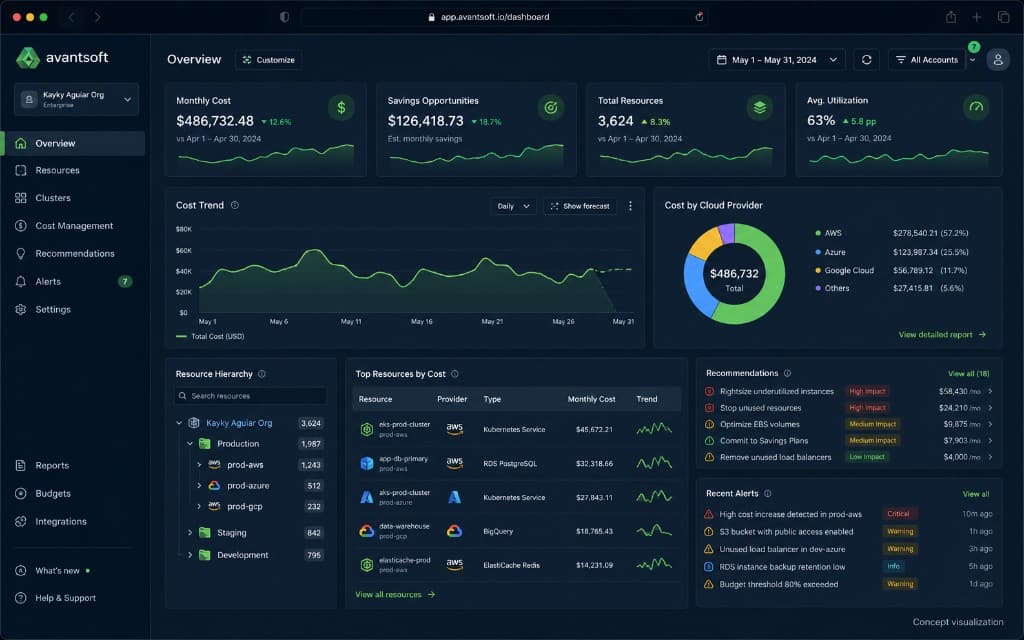
Concept visualization of the confidential cloud-management platform.
Product context
What the product was
The platform brought infrastructure information from multiple services into one administrative experience. Users needed to authenticate securely, navigate large resource structures, search across infrastructure data, inspect charts, and understand how technical decisions could affect resource utilization and cost.
The product was a confidential client engagement, so the public case study focuses on the engineering responsibilities and system design rather than disclosing the client or proprietary business information.
The challenge
Business and technical constraints
These were the product pressures the team needed to address. My engineering responses focused on the areas where I contributed.
Challenge 01
Fragmented infrastructure data
Resource information came from multiple services and needed to be presented through a consistent, responsive product experience.
Engineering response
Integrated external services through a dedicated Python aggregation layer and structured API responses for a maintainable React administration interface.
Challenge 02
Complex resource navigation
Users needed to understand relationships between organizations, environments, servers, clusters, and other resources without becoming lost in a dense administration interface.
Engineering response
Built hierarchical resource-tree navigation with search and filtering so teams could explore infrastructure relationships without losing context.
Challenge 03
Clear operational visualization
Large amounts of technical and cost-related information needed to be translated into understandable dashboards, search tools, resource trees, and dynamic charts.
Engineering response
Developed central dashboards, dynamic charts, and an animated savings visualization to make operational and cost-related information easier to interpret.
Challenge 04
Reliable production delivery
The system required maintainable frontend architecture, dependable APIs, automated testing, and consistent development and production environments.
Engineering response
Supported API and Playwright end-to-end tests, Dockerized environments, component-library maintenance, and production defect resolution within an Agile team.
My role
How I contributed
I worked as a Senior Full-Stack Engineer within an Agile product team. My responsibility was to turn complex infrastructure requirements into usable frontend workflows while supporting the backend services, APIs, testing strategy, and deployment consistency required by the platform.
- Frontend product development
- Backend and API integration
- Data visualization
- Component-library maintenance
- Automated testing
- Dockerized environments
- Team mentorship
- Agile collaboration
What I implemented
Personal engineering contributions
Work is grouped by delivery surface. These points describe what I personally built, supported, or contributed—not the full product ownership of every visible interface.
Frontend
React administration experiences for authentication, navigation, search, and operational insight.
- Built and enhanced a React-based web application for managing server and cloud resources
- Developed secure login and authenticated administration workflows
- Implemented a central dashboard for infrastructure information
- Created hierarchical resource-tree navigation
- Added resource search and filtering experiences
- Developed dynamic charts for operational and cost-related information
- Designed an animated savings visualization to make potential cost benefits easier to understand
- Contributed updates and bug fixes to an internal Angular component library
Backend & APIs
Service and API work that normalized infrastructure data for the product interface.
- Integrated information from multiple external services
- Developed and maintained Python services using FastAPI and Starlette
- Supported REST API development and integration
- Worked with Node.js and GraphQL within the central administration system
- Structured API responses for frontend consumption
- Improved data-delivery performance and responsiveness through a dedicated Python aggregation service
Integrations
Connecting the administration product to external infrastructure and data services.
- Aggregated infrastructure information from multiple external providers
- Supported GraphQL and REST communication within the administration system
- Prepared normalized operational data for dashboards, search, and charts
Quality & Collaboration
Testing, environments, mentorship, and delivery practices that kept the platform dependable.
- Created REST API automation tests with JavaScript and Chai
- Used native Promises for asynchronous test handling
- Wrote and maintained end-to-end tests with Playwright
- Configured Docker environments for development and production
- Supported production troubleshooting and defect resolution
- Mentored junior developers and shared code-quality practices
- Participated in recruiting and team-building activities
- Collaborated within Scrum delivery processes
Product capabilities
System capabilities
Capabilities of the product environment. Not every capability visible in the concept visualization was personally implemented by me.
- Authentication and administration
- Unified infrastructure overview
- Resource hierarchy
- Search and filtering
- Dynamic analytics
- Cost visibility
- Savings visualization
- External-service aggregation
- Alerts and recommendations
- Automated validation
Technical architecture
Platform architecture
The frontend consumed normalized information through a dedicated application and service layer rather than directly coupling UI components to multiple external providers. This separation helped keep the interface maintainable while allowing integrations and data sources to evolve.
Delivery surfaces
Frontend, backend, integrations, and quality
Frontend implementation
- React administration UI for login, dashboards, resource trees, search, and charts
- Reusable visualization and navigation patterns for dense infrastructure data
- Maintenance contributions to an internal Angular component library
Backend and API implementation
- Python FastAPI and Starlette aggregation services
- Node.js and GraphQL application-layer support
- REST integrations structured for frontend consumption
Integrations
- Multiple external infrastructure and data services
- GraphQL and REST communication within the administration system
- Normalized operational data feeding dashboards and charts
Testing and reliability
- REST API automation tests with JavaScript and Chai
- End-to-end coverage with Playwright
- Docker environments for development and production consistency
- Production troubleshooting and defect resolution
Collaboration and delivery
How the work moved forward
- 01Agile Scrum delivery with cross-functional product collaboration
- 02Mentorship for junior developers
- 03Recruiting and team-building participation
- 04Shared implementation guidance and code-quality practices
Outcome and product value
What the engineering work supported
Qualitative outcomes only. No unverified business metrics.
Engineering outcome
- Supported more responsive data delivery through a dedicated aggregation service
- Increased frontend maintainability through reusable components
- Reduced regression risk through API and end-to-end testing
- Improved consistency between development and production environments
Product value
- Centralized previously distributed resource information
- Made infrastructure relationships easier to explore
- Improved visibility into utilization and potential savings
Team value
- Strengthened reusable foundations for continued platform evolution
- Shared mentorship and delivery practices across the engineering team
Technology stack
Tools used on this engagement
- React
- TypeScript
- Node.js
- GraphQL
- Python
- FastAPI
- Starlette
- Angular
- Chai
- Playwright
- Docker
Reflection
What I learned
This project strengthened my ability to turn dense infrastructure data into understandable product experiences. It also reinforced the value of clear service boundaries, reusable frontend architecture, and automated validation when building administration platforms that must evolve over time.