02 / Case Study
Telehealth Administration & Virtual Care Platform
A healthcare administration and virtual-care platform supporting scheduling, appointment booking, provider workflows, payments, subscriptions, messaging, and real-time consultations.
I contributed to the frontend architecture, reusable React and TypeScript components, third-party integrations, real-time communication features, testing, and Agile product delivery.
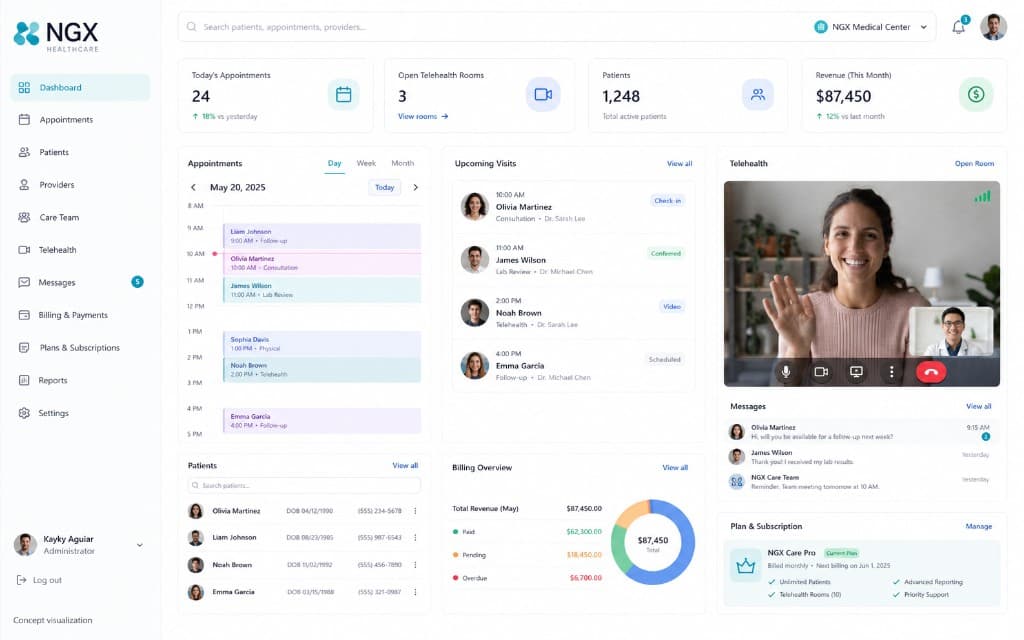
Concept visualization of the confidential healthcare administration platform.
Product context
What the product was
The platform gave healthcare administrators and service providers one place to coordinate operational workflows. The product needed to support multiple types of interaction, including appointment management, administrative tasks, payment and subscription workflows, and remote consultation.
Because this was a confidential client platform, the case study presents the engineering scope without exposing the organization or private healthcare data.
The challenge
Business and technical constraints
These were the product pressures the team needed to address. My engineering responses focused on the areas where I contributed.
Challenge 01
Multiple connected workflows
Scheduling, booking, administration, payments, subscriptions, and consultations needed to feel like parts of one coherent product.
Engineering response
Implemented connected administration, scheduling, payment, and subscription interfaces on a shared React and TypeScript foundation.
Challenge 02
Reusable frontend architecture
The product needed reusable components and frontend services that could work with different REST schemas and third-party providers.
Engineering response
Created reusable React components and an abstract frontend architecture capable of working with different REST API schemas.
Challenge 03
Responsive and reliable experiences
Administrators and providers needed responsive interfaces that remained usable across devices and under changing product requirements.
Engineering response
Improved responsive behavior and visual consistency while collaborating with designers on UI and UX details.
Challenge 04
Real-time communication
Virtual consultations required dependable browser-based communication and clear user controls.
Engineering response
Integrated Twilio services and WebRTC to support browser-based virtual consultation workflows with clear interaction states.
Challenge 05
Fast MVP delivery
The Agile team needed to deliver an initial MVP within approximately three months while maintaining testing and visual consistency.
Engineering response
Participated in client discovery, Jira-based Agile delivery, and automated testing to help ship the MVP within approximately three months.
My role
How I contributed
As a Full-Stack Engineer, I focused heavily on frontend product architecture while also contributing to Node.js services, integrations, backend APIs, testing, and client-facing delivery. I worked closely with designers, stakeholders, and engineers to translate healthcare workflows into reusable product features.
- React and TypeScript development
- Responsive administration UI
- Component architecture
- Appointment and booking workflows
- Payments and subscriptions
- Real-time communication
- API integrations
- Testing
- Client requirement discovery
- Agile delivery
What I implemented
Personal engineering contributions
Work is grouped by delivery surface. These points describe what I personally built, supported, or contributed—not the full product ownership of every visible interface.
Frontend
Administration interfaces, reusable components, and responsive healthcare workflows.
- Developed the administration interface with React, TypeScript, and Tailwind CSS
- Created reusable React components and frontend services
- Implemented dashboard and administration workflows
- Supported appointment scheduling and booking experiences
- Built payment and subscription interfaces
- Developed React and Vue applications
- Created an abstract frontend architecture capable of working with different REST API schemas
- Improved responsive behavior and visual consistency
- Collaborated with designers on UI and UX details
Backend & APIs
Services and data layers supporting operational healthcare workflows.
- Contributed to Node.js services
- Worked with MongoDB-backed application functionality
- Built Django REST APIs for data-management requirements
- Added custom data filters using Elasticsearch
- Integrated frontend workflows with REST services and third-party providers
Integrations
Real-time communication and third-party service connections for virtual care.
- Integrated Twilio communication services
- Supported browser-based virtual consultation workflows
- Used WebRTC for real-time communication
- Developed clear controls and states for virtual interactions
Quality & Collaboration
Testing, client collaboration, and Agile delivery around the MVP.
- Wrote frontend unit tests with Jest and Mocha
- Used TypeScript to improve reliability and maintainability
- Implemented end-to-end test coverage with Playwright
- Validated critical scheduling and administration workflows
- Supported defect resolution during MVP delivery
- Participated in client meetings and requirement gathering
- Used Jira within an Agile delivery process
- Helped deliver the MVP within approximately three months
Product capabilities
System capabilities
Capabilities of the product environment. Not every capability visible in the concept visualization was personally implemented by me.
- Administration dashboard
- Appointment scheduling
- Booking management
- Provider workflows
- Patient-facing operational support
- Virtual consultations
- Messaging
- Payments
- Subscriptions
- Third-party service integration
- Responsive interfaces
- Automated testing
Technical architecture
Platform architecture
The frontend was structured around reusable components and service abstractions so product workflows could integrate with different APIs and third-party providers without tightly coupling each screen to a single response format.
Delivery surfaces
Frontend, backend, integrations, and quality
Frontend implementation
- React, TypeScript, and Tailwind administration interfaces
- Reusable components and frontend services across workflows
- Responsive design collaboration with product designers
Backend and API implementation
- Node.js services and MongoDB-backed functionality
- Django REST APIs for data-management requirements
- Elasticsearch filters for operational data access
Integrations
- Twilio communication services
- WebRTC for browser-based virtual consultations
- REST and third-party provider integrations
Testing and reliability
- Frontend unit tests with Jest and Mocha
- End-to-end coverage with Playwright
- Validation of critical scheduling and administration workflows
- Defect resolution during MVP delivery
Collaboration and delivery
How the work moved forward
- 01Client meetings and requirement clarification
- 02UI and UX refinement with designers and stakeholders
- 03Jira-based Agile delivery
- 04Cross-functional MVP launch support
Outcome and product value
What the engineering work supported
Qualitative outcomes only. No unverified business metrics.
Engineering outcome
- Created reusable foundations for multiple healthcare workflows
- Supported continued product evolution through an abstract frontend architecture
- Reduced regression risk through automated testing
Product value
- Helped deliver an MVP within approximately three months
- Supported scheduling, administration, payment, and subscription capabilities
- Enabled real-time virtual-care interactions
- Improved visual and functional consistency
Team value
- Strengthened collaboration between engineering, design, and client stakeholders
- Supported a delivery process that balanced speed with maintainability
Technology stack
Tools used on this engagement
- React
- TypeScript
- Vue
- Tailwind CSS
- Node.js
- Django
- MongoDB
- Elasticsearch
- Twilio
- WebRTC
- Jest
- Mocha
- Playwright
- Jira
Reflection
What I learned
This engagement strengthened my understanding of how sensitive, multi-step workflows should be translated into clear interfaces. It also demonstrated how reusable architecture and close collaboration with designers and clients can support rapid delivery without treating maintainability as an afterthought.